
In our Mexican pharmacy you can find medications for treating eye diseases, but first, let’s look at what eye diseases do exist.
Note: we are not a medical institution and cannot give treatment recommendations. Our articles are for guidance only. In any case, you should consult with your doctor.
The most common eye diseases are:
• Conjunctivitis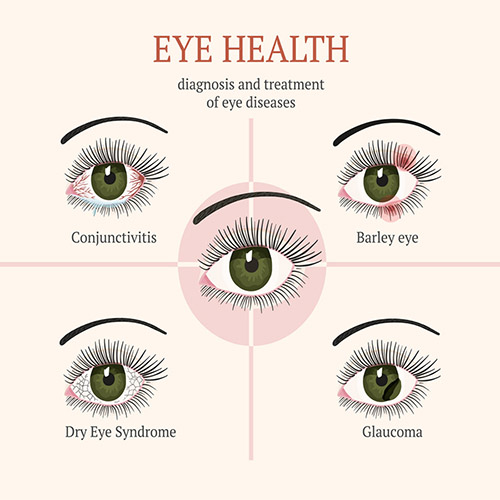
• Bacterial blepharitis
• Keratitis
• Eye allergy
• Glaucoma
• Cataract
• Fabry disease
• Retinitis pigmentosa
• Other diseases
In this article, we will consider a disease such as conjunctivitis.
Conjunctivitis
Conjunctivitis is an inflammation of the conjunctiva. The conjunctiva is a transparent membrane that covers the eyeball and the inside of the eyelids. The disease is also called pink eye syndrome.
Inflammation of the mucous membrane of the eye occurs due to the virus, less often due to bacteria. There are about a dozen variations of conjunctivitis, but in most cases the adenovirus is the focus of the disease.
Types of conjunctivitis
The most common species are viral or bacterial, acute, chronic and allergic conjunctivitis. A combination of conjunctivitis and other eye diseases is also distinguished, for example, blepharoconjunctivitis, keratoconjunctivitis.
For each type of conjunctivitis, an individual treatment should be selected. There is no universal medication.
Signs of viral conjunctivitis
Viral conjunctivitis most often occurs against the background of the common cold, throat disease. Infection begins to occur first on one eye, then on the other. The first signs of viral conjunctivitis:
• Pain in the corner of the eye, discomfort, burning
• The conjunctiva is red;
• Redness of blood vessels;
• Swelling of the eyelids;
• Photophobia;
• Eye discharge may be present;
• A follicle or film may appear (more common in children).
With adenoviral conjunctivitis, there are also signs of a cold: fever, damage to the respiratory tract, swollen lymph nodes, sore throat.
Signs of bacterial conjunctivitis
Bacterial conjunctivitis is caused by pyogenic bacteria. Bacterial conjunctivitis is characterized by morning adhesion of the eyes, since it is the bacteria that causes the discharge from the eyes. Infection is not always characterized by these symptoms, in some patients there was only a foreign body sensation in the eye. Dryness can also be felt, both the shell of the eye and the skin around. Sometimes this type of conjunctivitis causes pain.Symptoms usually occur on the 3rd day after infection.
Important! Viral and bacterial conjunctivitis should be treated differently, since in the first case, antibiotics that act on the virus should be prescribed, and in the second, antibacterial drugs. The doctor also determines if anti-inflammatory drugs are needed. Therefore, if you decide to order medications for the eyes in our Mexican pharmacy, be sure to consult your doctor.
Acute conjunctivitis
In acute conjunctivitis, pain in the eyes, mucous or purulent discharge is noted. It is in the acute form that infiltrates, corneal ulcers can occur. With the course of the disease, small hemorrhages of the sclera and its edema occur.
Chronic conjunctivitis
The most dangerous among all types of conjunctivitis is chronic. The danger is that the symptoms may be tolerable for the patient, however, despite this, the eye is still affected, which can lead to visual impairment.
The cause of chronic conjunctivitis may be untimely diagnosis, improper medication, weakening of the immune system, interruption of treatment. In the case of a decrease in immunity, the body is not able to fully cope with the infection. Other causes of development may be the use of cosmetics that cause allergies, dust or shavings, structural features of the eye (for example, improper eyelash growth), contact lenses, and other chronic diseases.
Symptoms of chronic conjunctivitis: a feeling of fatigue in the eyes, decreased vision (especially in the evening), redness of the conjunctiva and scleral membrane. Many patients complain that they feel “sand” under the eyelid.
Allergic conjunctivitis
Conjunctival inflammation is due to exposure to an allergen. Too high sensitivity to an antigen, such as pollen from plants, animals, ticks, causes irritation to the lining of the eyes.
Symptoms of allergic conjunctivitis:
• Light / Intense itching of the mucous membranes of the eyes and eyelids
• Sensitivity or fear of light;
• Swelling of the eyelids;
• Discharge from the eyes.
Most often, allergic conjunctivitis is accompanied by other symptoms: runny nose and sneezing, eczema, rhinitis, asthma.
Conjunctivitis treatment
It should be said right away that if the disease is not treated, it can develop to the marginal corneal ulcer, keratitis, or go into a chronic form.
Treatment of viral conjunctivitis should be carried out with specific antiviral drugs of interferon type alpha 2. The doctor may prescribe warm compresses, rinsing with special solutions and taking tablets. Drops, which include an antibiotic, can also be prescribed.Treatment of bacterial conjunctivitis is carried out with broad-spectrum antibiotics, as well as washing with solutions with an antiseptic composition.
Allergic conjunctivitis is treated with antihistamines of various forms: tablets, drops. To eliminate the drying of the mucosa, drops of an artificial tear are used. The doctor can also prescribe steroids to relieve inflammation, rinsing with antiseptic solutions, cool compresses.
What to avoid during the course of conjunctivitis
During the disease, the following actions must be observed:
• Do not smoke, avoid wind and cold air from the air conditioner
• Rinse eyes regularly with a special solution
• Use a humidifier.
Prevention during an illness consists of several steps:
1. Change pillowcases more often
2. Clean your makeup tools daily and don’t transfer your makeup
3. Do not hand over your handkerchiefs; change the towel
4. Wash your hands constantly
5. Remove contact lenses on time, clean them properly
6. Do not rub your eyes with dirty hands.
In our Mexican pharmacy, the Eye Care section contains medicines for the treatment of various types of conjunctivitis. You should definitely consult your doctor so that he prescribes:
1. Type of medication in your case
2. Form of the drug: tablets, ointment or drops
3. Dosage
4. Duration of treatment
5. Additional therapy if necessary.
We hope our article Pink Eye Symptoms Treatment has been helpful to you. If your doctor has already prescribed preparations for the treatment of pink eyes, then you can order them at a low price if this problem periodically bothers you.